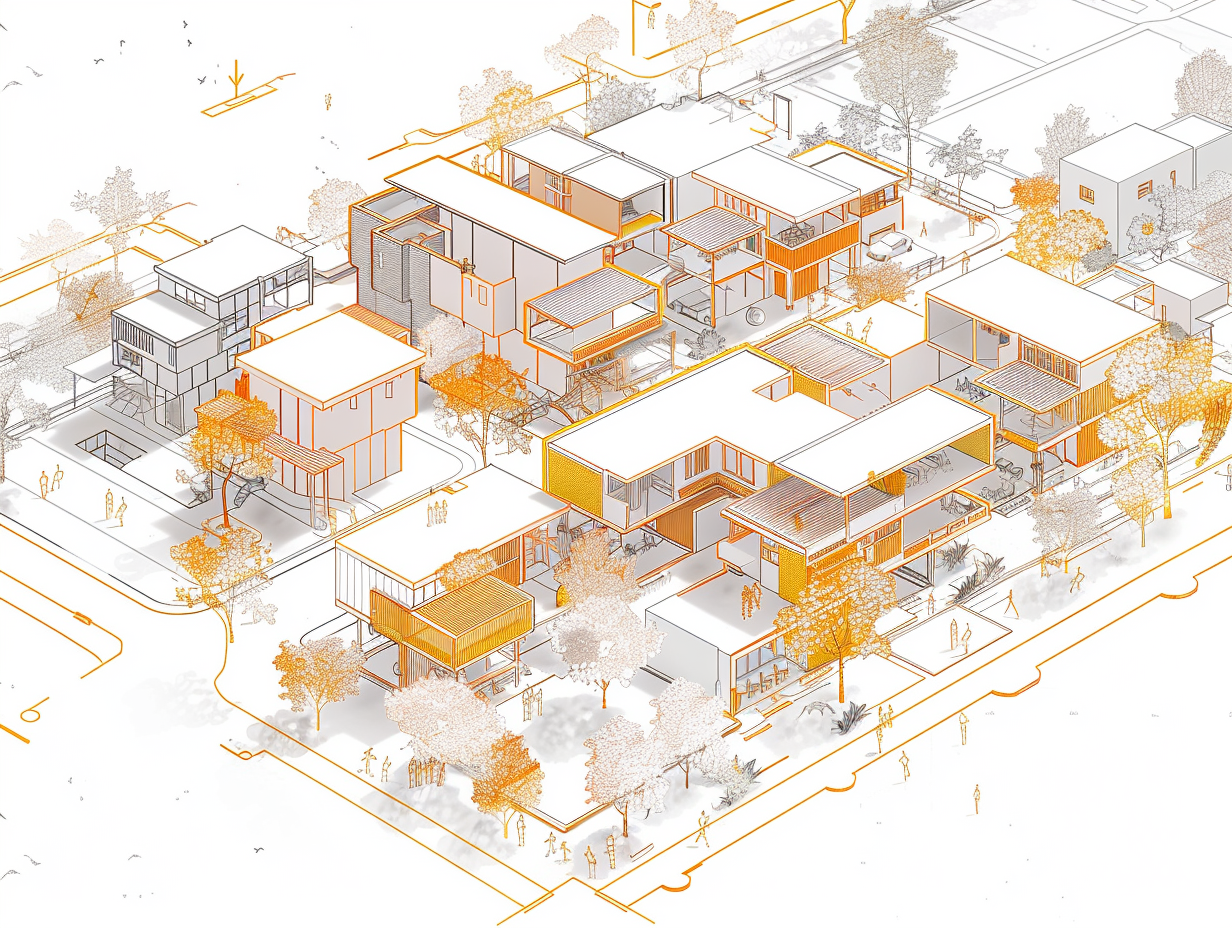
Postwar reconstruction often treats speed as virtue: clear debris, re-grid streets, restore utilities, and deliver housing as quickly as possible. Yet the fastest method—tabula rasa clearance—can erase the very cues through which a city remembers itself: parcel lines, street traces, scars, and the accumulated routines of everyday life. When those cues disappear, the rebuilt city risks becoming interchangeable, a “city that could be anywhere.” This article reframes “reconstruction without erasing history” not as a binary choice between preservation and redevelopment, but as a design practice of editorial distribution—allocating memory across multiple media so it can survive inevitable urban updates.

Three strategies are presented as an actionable design language. (1) Monumentalization concentrates meaning into a durable core: a memorial, landmark, or spatial focus that anchors public commitment. Its strength is symbolic clarity; its risk is narrative simplification. The key is to connect the symbolic core to daily circulation and learning routes, rather than isolating it as a standalone object. (2) Preserved buildings retain tactile, inhabitable evidence of the past. However, they demand structural safety, long-term maintenance, and political legitimacy. Preservation becomes viable when coupled with adaptive reuse—embedding the building into urban functions such as community facilities, libraries, workshops, or civic programs, thereby transforming “heritage” into a lived resource. (3) Trace-preservation distributes memory across the ground plane and boundaries: remnants of foundations, shifts in paving patterns, subtle level differences, fragments of walls, and encoded street alignments. Even when full building retention is impossible, traces can be woven into public space as a resilient, everyday encounter with history.
The article then draws principles from postwar urban precedents: Warsaw’s Old Town, where reconstruction itself became historically meaningful through documentation and collective agency; Hiroshima, where the atomic ruin was stabilized as a central, irreducible witness; and Berlin and Coventry, where ruins and new construction were deliberately juxtaposed to render temporal rupture legible rather than “resolved.” From these cases, the article proposes a practical checklist for a “memory infrastructure” within reconstruction: combine a symbolic point with distributed surfaces; publish archives and reconstruction rationales; design contrast between old and new to enhance temporal readability; treat safety and maintenance as inseparable from preservation; tether memory sites to everyday life to avoid mere consumption by tourism; and embed memory clauses into planning documents, budgets, and governance so that remembrance does not depend on goodwill alone.
Ultimately, reconstruction without erasing history is not the pursuit of perfect restoration. It is the sustained translation of how a city was broken, repaired, and kept—into an urban grammar that can be re-edited with each redevelopment cycle. To reconcile reconstruction speed with identity continuity, cities must build not only physical infrastructure, but also infrastructure for memory.
Reference (main)
- nternational Council on Monuments and Sites (ICOMOS). (1964). International charter for the conservation and restoration of monuments and sites (The Venice Charter 1964).
- International Council on Monuments and Sites (ICOMOS). (1994). The Nara document on authenticity. (Nara Conference on Authenticity in Relation to the World Heritage Convention, 1–6 November 1994)