
This article argues that Japan’s postwar housing shortage and today’s vacant-house (akiya) crisis form a continuous policy story rather than two unrelated problems. In the immediate post–World War II period, war damage, evacuation-related demolition, and repatriation generated an estimated net shortage of roughly 4.2 million dwellings nationwide, creating a political imperative to maximize supply as quickly as possible. Government responded by institutionalizing a “build-more” paradigm through direct provision and finance—public housing, public corporation development, and state-backed mortgage lending—supported by national long-term construction planning. These instruments were highly effective under conditions of rapid urbanization, population growth, and household formation. However, the same system produced strong path dependence: it normalized new-build solutions, reinforced owner-occupied asset logics, and locked housing supply to infrastructure footprints and land-use patterns that are slow to adjust. As demographic and economic conditions reversed, surplus emerged. By 2023, Japan recorded 9.0 million vacant units and a vacancy rate of 13.8%, with a substantial share categorized as non-market “other” vacancies that are difficult to circulate or repurpose. The article proposes a future-oriented shift from “quantity of new supply” to “operations of existing stock,” emphasizing low-friction mobility (downsizing and near-distance moves), design-for-reconfiguration (flexible plans and adaptive reuse), and area-based “reconnection” that bundles vacant homes into walkable service ecosystems aligned with compact-city strategies. Reframing housing as an editable, interoperable system can turn the legacy of postwar expansion into a platform for resilient living in an era of population decline. This perspective links reconstruction history to smart-city governance and community-scale management models today.
Introduction
Japan’s housing challenge has flipped over the past eight decades: from an urgent postwar scarcity to a contemporary condition of surplus. At first glance, “not enough” and “too much” appear to be opposites. Yet they are connected by policy momentum and by the long physical life of housing stock. This paper examines that continuity: how postwar solutions optimized for rapid expansion became a structural constraint under population decline, and how “relocation” and “re-editing” (adaptive reconfiguration of stock) can serve as a forward-looking framework for future living environments.
Postwar Reconstruction: Housing as an Emergency Quantity Problem
Immediately after WWII, Japan faced a severe housing deficit. Contemporary policy accounts and institutional histories describe an estimated nationwide shortage on the order of 4.2 million dwellings, driven by war destruction, wartime evacuation measures, and postwar repatriation. (Retio)
Under these conditions, housing policy prioritized speed and volume. A set of instruments—often characterized as the postwar “three pillars”—became institutionally established: public housing, public corporation–led development, and state-backed housing finance (via government mortgage lending). (mlit.go.jp)
National-level long-term planning further reinforced a supply-expansion logic, aiming to close the gap between households and units and to respond to accelerating urban concentration. (mlit.go.jp)
In the scarcity era, this architecture made sense. When demand is rising sharply, any delay in production compounds social risk: overcrowding, public health deterioration, labor instability, and the inability of cities to absorb returning and migrating populations. Housing was treated as foundational infrastructure for economic recovery.
The Great Reversal: From Growth Conditions to Demographic Contraction
Today’s akiya problem emerges from changed demand conditions rather than a sudden failure of construction capacity. In 2023, Japan’s Housing and Land Survey (preliminary results) reported 9.0 million vacant units and a vacancy rate of 13.8%, both record highs. (stat.go.jp)
Crucially, not all vacancies behave the same. Beyond units temporarily vacant for rent/sale or secondary use, a large portion falls into “other” vacancy categories—units that often lack a clear market pathway and may be unmanaged, legally complex, or physically obsolete. (stat.go.jp)
This is the signature of the “surplus era”: not merely too many units in aggregate, but too many units in the wrong places, forms, and ownership configurations for current demographic realities.
Why the Two Problems Are Connected: Path Dependence in Housing Systems
The postwar “build-more” paradigm solved scarcity, but it also produced durable path dependence that becomes visible when conditions reverse.
- Normalization of new-build solutions.
Scarcity policy trained institutions and markets to equate “housing problem” with “housing production,” making it difficult to pivot toward circulation and reuse when supply becomes abundant. - Ownership and fixity as default.
Policy and finance frameworks supported stable, long-term dwelling as an asset and household anchor. That stability is beneficial in growth phases, but it raises friction for relocation and resizing in aging and shrinking communities. - Lock-in to infrastructure footprints.
Housing development tied to roads, utilities, schools, and employment geography cannot easily shrink or relocate. When population distribution changes, the built environment adjusts slowly, leaving pockets of surplus and decay.
In short, the connection is not that postwar policy “caused” akiya directly, but that it created a highly effective expansion machine whose assumptions (growth, urban pull, household formation) became misaligned with later demographic and economic trajectories.
Policy and Design Shift: From “Producing Units” to “Operating Stock”
A future-oriented response requires changing the “policy object” from new supply quantity to existing stock operations. Guidance for municipal housing policy planning in Japan positions local plans as master frameworks for addressing housing challenges in place-specific ways—an approach compatible with stock-centered strategies, including akiya management and local market functioning.
Three practical directions follow.
1) Make relocation low-friction and normal
Relocation (downsizing, near-distance moving, partial renting) should be treated as everyday infrastructure: simplified procedures, predictable costs, and supportive services. When movement becomes easier, households can match dwelling size and location to life stage, reducing “stranded” surplus.
2) Design homes to be re-edited, not finalized
“Re-editing” means enabling a unit to change without being demolished: flexible partitions, service-core strategies, upgrade-ready mechanical/electrical systems, and clear rules for change-of-use (e.g., live–work, care support, community micro-hubs). The goal is to turn housing into a platform rather than a one-time product.
3) Reconnect vacant homes to compact, walkable service ecosystems
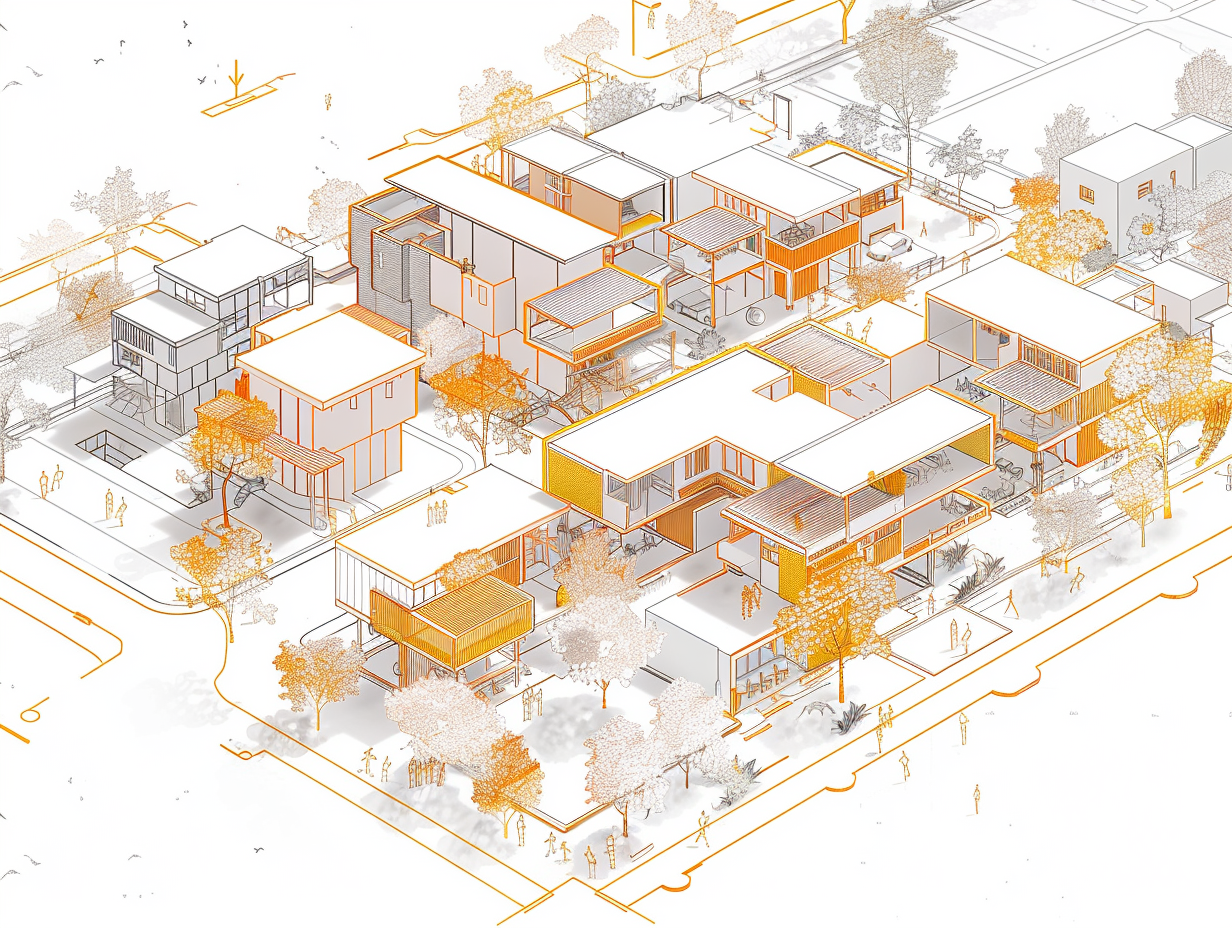
Akiya is rarely solvable one unit at a time. Area-based “reconnection” bundles dispersed vacancies into corridors or districts where mobility, healthcare access, education, safety, and climate resilience can be managed together—aligning with compact-city thinking and smart governance models. This reframes surplus stock as a resource for reorganizing community services at a manageable scale.
Conclusion
Postwar Japan optimized for urgent housing provision, institutionalizing a powerful expansion toolkit. That toolkit succeeded under growth conditions—but under demographic contraction it creates lock-in, leaving a large and heterogeneous vacant stock. The strategic pivot is to treat housing as an editable system: enable relocation as a normal practice, redesign dwellings for reconfiguration, and manage vacancies through area-based reconnection to services. In doing so, the legacy of reconstruction can be transformed from a growth engine into a resilience platform for the future city.
Reference (main)
Ministry of Land, Infrastructure, Transport and Tourism. (n.d.). Housing long-term planning: How long-term housing plans should be structured.
Ministry of Land, Infrastructure, Transport and Tourism. (2022). Guide for municipal basic plan for housing life.
Real Estate Transaction Promotion Center (RETIO). (2024). Chapter 4: Real estate policy in the postwar reconstruction period.