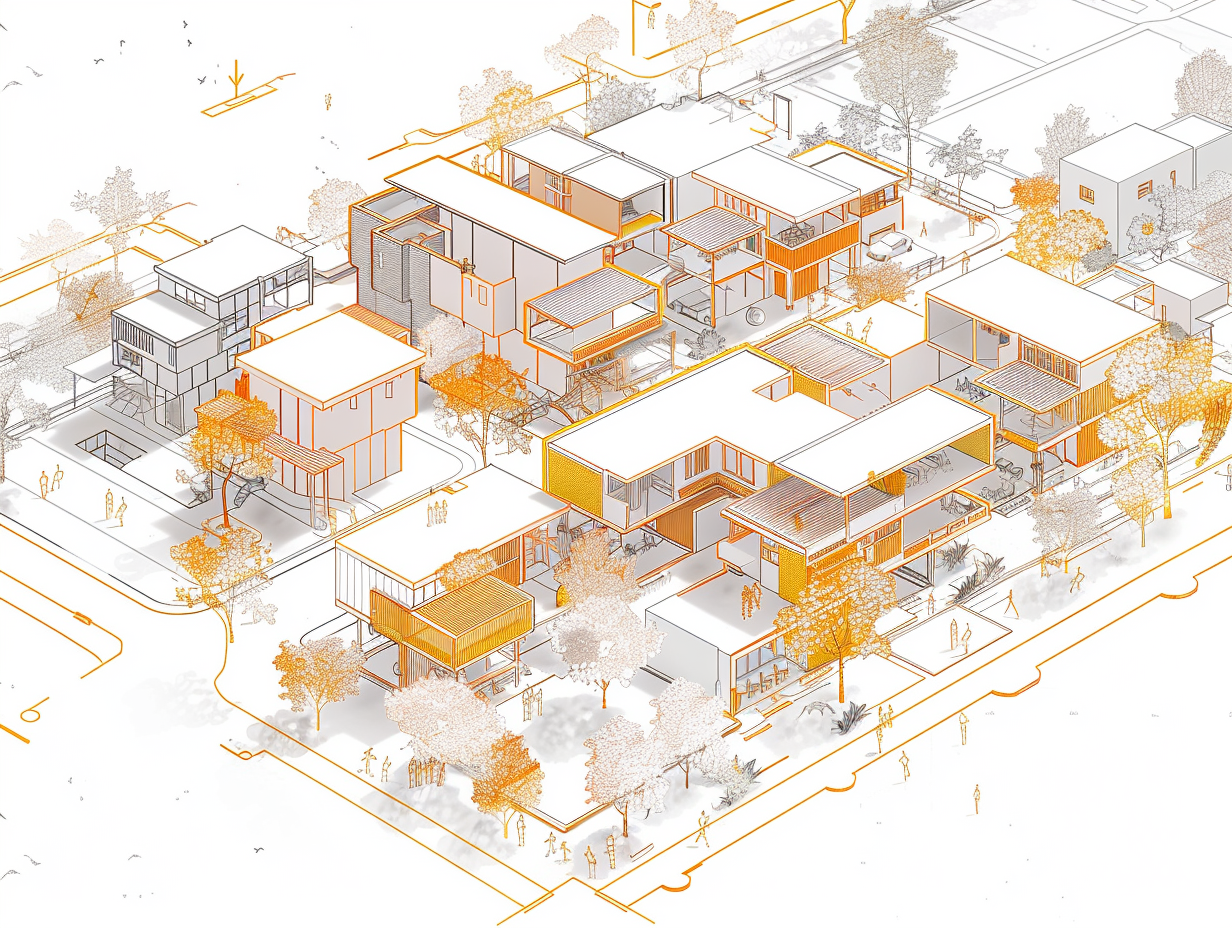
In post-disaster and postwar reconstruction, “landscape” (urban aesthetics) is often treated as a secondary concern—something to be addressed after housing and infrastructure. This article argues the opposite: landscape quality functions as an operational recovery indicator that shapes whether residents return, businesses reopen, and capital reinvests. Elements such as color palettes, material choices, outdoor advertising controls, and nighttime lighting are not decorative add-ons but signals of safety, governance capacity, and everyday livability. People decide to return based on perceived normalcy: continuous walkable routes at night, coherent signage, active storefront lighting, and maintained public space communicate that the city is functioning. Investors and operators likewise respond not only to demographic and policy data but to on-site confidence—an intuitive assessment that the district “runs” across the full day-night cycle. Nighttime lighting is especially pivotal: beyond crime prevention, it enables the night economy and extends dwell time, supporting retail, food services, and cultural activity. Outdoor advertising should be understood as an information layer that can either degrade trust through visual noise or raise circulation through legible, coordinated rules (height, brightness, typography, and color temperature). To future-proof recovery, this article proposes a simple KPI framework—Color, Materials, Advertising, and Light—tracked by district and linked to mobility, vacancy, and rental indicators. By integrating landscape into phased reconstruction (emergency → interim → permanent), cities can accelerate social return and investment readiness, transforming “beauty” into a practical lever of urban resilience and competitiveness.

1. Introduction
Reconstruction planning commonly prioritizes housing and lifelines while relegating landscape to a later phase. Yet landscape—how a city looks and feels—directly influences return decisions and investment behavior. Rather than treating aesthetics as “luxury,” recovery programs can operationalize landscape as a measurable indicator of lived normalcy.
2. Why Landscape Determines Return
Residents avoid places that feel unsafe or inactive. Night walkability, coherent signage, lit windows, and maintained streets convey social presence and informal surveillance. In recovery districts, these cues often outweigh numerical indicators in the first months and years, because they translate abstract progress into immediate, embodied confidence (Kesennuma City, n.d.).

3. Investment Responds to Confidence, Not Only Data
Investors and tenants evaluate more than incentives and population projections. They assess whether a district performs—whether circulation, maintenance, and nighttime activity are credible. Public policy frameworks that emphasize walkability and high-quality public space increasingly connect urban design to value creation and competitiveness (MLIT, n.d.). Strategic visions developed after major disasters also highlight integrated urban quality—not only rebuilding what was lost, but upgrading the city’s future appeal (City of Kobe, n.d.).
4. Outdoor Advertising as Urban Editing
Outdoor advertising is an information layer. In reconstruction phases, temporary signs can proliferate and visually fragment streets. The goal is not blanket prohibition but editorial coordination: rules for placement height, typography, luminance, and glare control can improve legibility and pedestrian circulation while protecting district character (UDC, 2017).
5. Nighttime Lighting: From Safety to the Night Economy
Lighting design must avoid discontinuities and sharp brightness contrasts that create anxiety. Beyond crime prevention, lighting activates evening movement and dwell time—supporting restaurants, retail, and cultural uses. Research discussions on nighttime environments note how street conditions and illuminance differences relate to crime perceptions and suppression strategies (ISFJ, 2014). In recovery contexts, the fastest “proof of life” is often a functioning night scene.
6. A Practical KPI Framework for Future-Ready Recovery
To integrate landscape into phased reconstruction (emergency → interim → permanent), track four indicators by district and correlate them with mobility and vacancy metrics:
- Color: number and coherence of dominant hues across façades, paving, and signage
- Materials: transition from provisional to tactile, durable finishes (wood/stone/metal/planting)
- Advertising: reduction of temporary clutter; improvement of wayfinding readability and universal access
- Light: continuity of nighttime routes; distribution of “inhabited” window/storefront light; glare control
This converts “beauty” from taste-based debate into an investment-facing language aligned with measurable recovery performance.
The manuscript concludes that urban recovery is the technique of restoring the city’s “metabolism.” A cross-sector “minimum service package” (water–power–transport) should be planned and delivered as a single integrated program across the three phases, enabling a safe, stable, and ultimately more resilient city than before.
Reference (main)
International Committee of the Red Cross (ICRC). Urban services during protracted armed conflict: A call for a better approach to assisting affected people (2015).
UN-Habitat. Sustainable Reconstruction Framework (SRF) (2023).
UNDP. Sustainable Reconstruction Framework (2023).
World Bank. Disaster Recovery Framework Guide (2020).